
We often convince ourselves that massive success requires massive action. We put pressure on ourselves to make some earth-shattering improvement that everyone will talk about. But in reality, the most profound transformations don’t come from a single leap—they come from Atomic Habits.
Based on the core principles of James Clear’s philosophy, here is how you can stop chasing “overnight success” and start building a system that makes failure impossible.
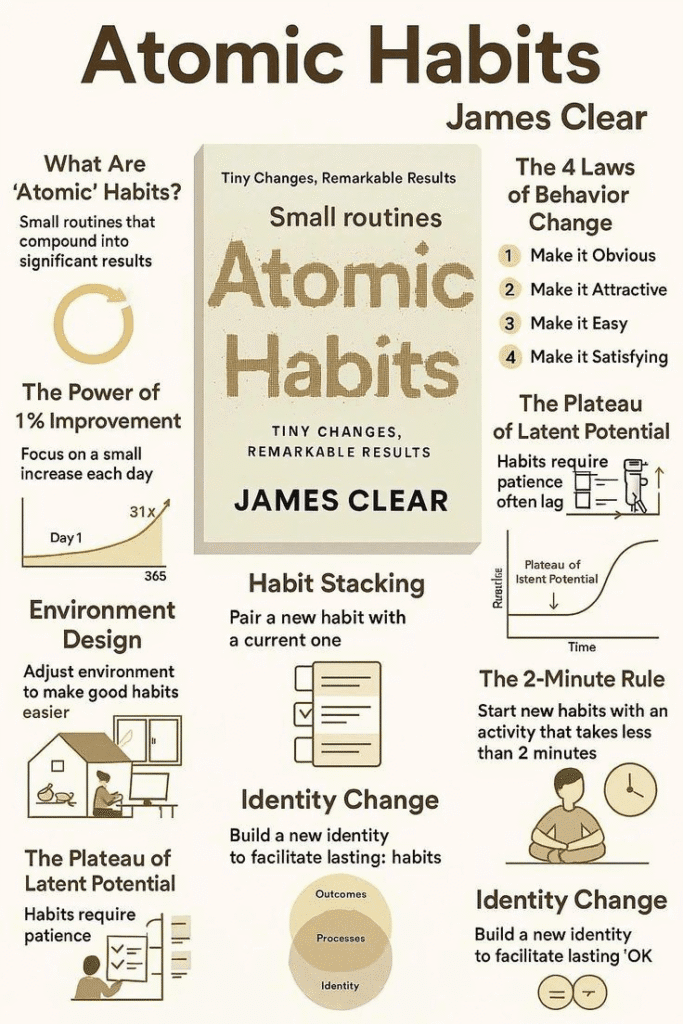
1. The Power of 1% Improvement

Most people overlook small choices because they don’t seem to matter in the moment. However, habits are the compound interest of self-improvement. If you can get just 1% better each day, you will be 37 times better by the end of the year.
Small wins don’t just add up; they compound. Whether it’s reading one page or doing one push-up, these tiny “atoms” of behavior are the building blocks of remarkable results.
2. Environment Design: The Invisible Hand

Willpower is a finite resource. If you have to fight your environment every day to do the right thing, you will eventually lose. Environment Design is about making the good habits the path of least resistance.
- Want to drink more water? Place a bottle on your desk every morning.
- Want to practice guitar? Take it out of the case and stand it in the middle of the living room.Stop being the victim of your environment and start being the architect of it.
3. The Plateau of Latent Potential

This is where most people quit. You work out for a month, and the scale hasn’t moved. You feel like you’re failing, but you are actually experiencing the Plateau of Latent Potential.
Habits often appear to make no difference until you cross a critical threshold. Your work isn’t wasted; it’s being stored. Like an ice cube that doesn’t melt at 31 degrees but finally breaks at 32, your breakthrough is the result of all the previous efforts where “nothing” seemed to happen.
4. Habit Stacking: The Secret to Consistency

The best way to start a new habit is to “stack” it onto an existing one. The formula is simple: After [Current Habit], I will [New Habit].
- “After I pour my morning coffee, I will meditate for one minute.”
- “After I take off my work shoes, I will immediately change into my gym clothes.”By tethering a new behavior to an established anchor, you bypass the need for a “reminder.”
5. Identity Change: The Ultimate Shift

Most people focus on what they want to achieve (outcomes). The real secret to lasting change is focusing on who you want to become (identity).
Every action you take is a vote for the person you want to be. You aren’t just “going for a run”; you are “becoming a runner.” When the behavior is aligned with your identity, you no longer have to pursue change—you are simply acting like yourself.
6. The 4 Laws of Behavior Change
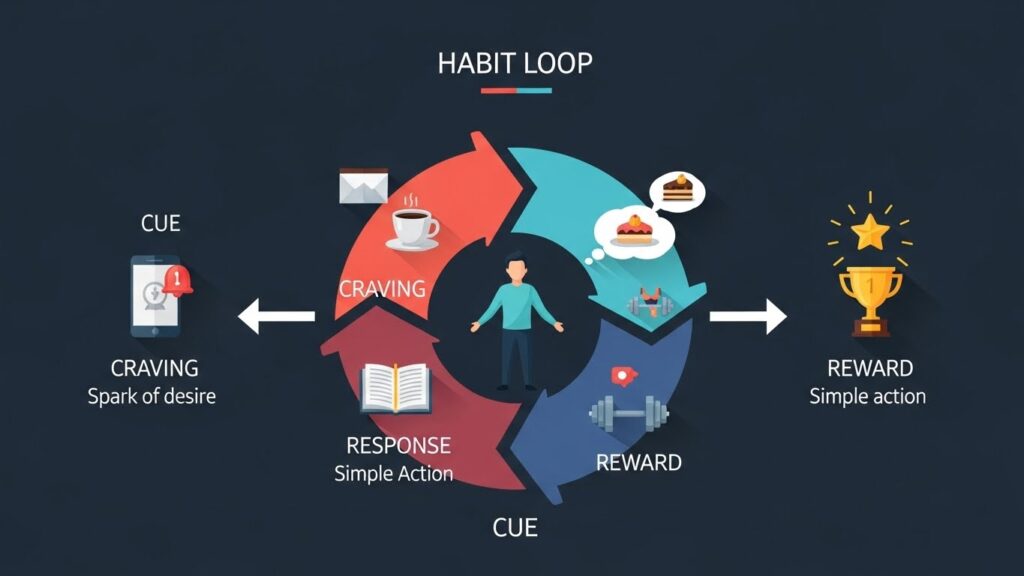
To master your habits, you must understand the four-step loop that governs every behavior:
- Cue (Make it Obvious): Use visual triggers.
- Craving (Make it Attractive): Pair the habit with something you enjoy.
- Response (Make it Easy): Reduce the number of steps between you and the habit.
- Reward (Make it Satisfying): Give yourself an immediate “win” to reinforce the loop.
7. The 2-Minute Rule

Stop overcomplicating your goals. When you start a new habit, it should take less than two minutes to do.
- “Read before bed” becomes “Read one page.”
- “Yoga for 30 minutes” becomes “Take out my yoga mat.”A habit must be established before it can be improved. If you can’t show up for two minutes, you’ll never show up for an hour.
Focus on Systems, Not Goals
Goals are about the results you want to achieve; systems are about the processes that lead to those results. If you ignore your goals and focus only on your 1% improvements and environment design, you would still win.
What is one “2-minute” version of a goal you’ve been putting off? Share it in the comments, and let’s start voting for our new identities today.
